
I. The Role of Heating in Mashing
Heating is fundamental to mashing. The mash tun must raise the temperature of the grist-water mixture through specific rests — typically 45°C for beta-glucanase, 62-65°C for beta-amylase, 68-72°C for alpha-amylase, and 76-78°C for mash-off. How the heat is delivered affects not only the speed of temperature rise but also the uniformity of heat distribution, enzyme activity, and ultimately the fermentability and flavor profile of the wort.
Two dominant heating methods exist in commercial brewhouses: direct fire heating and steam jacket heating. Each has distinct characteristics that influence wort quality and brewhouse operation.
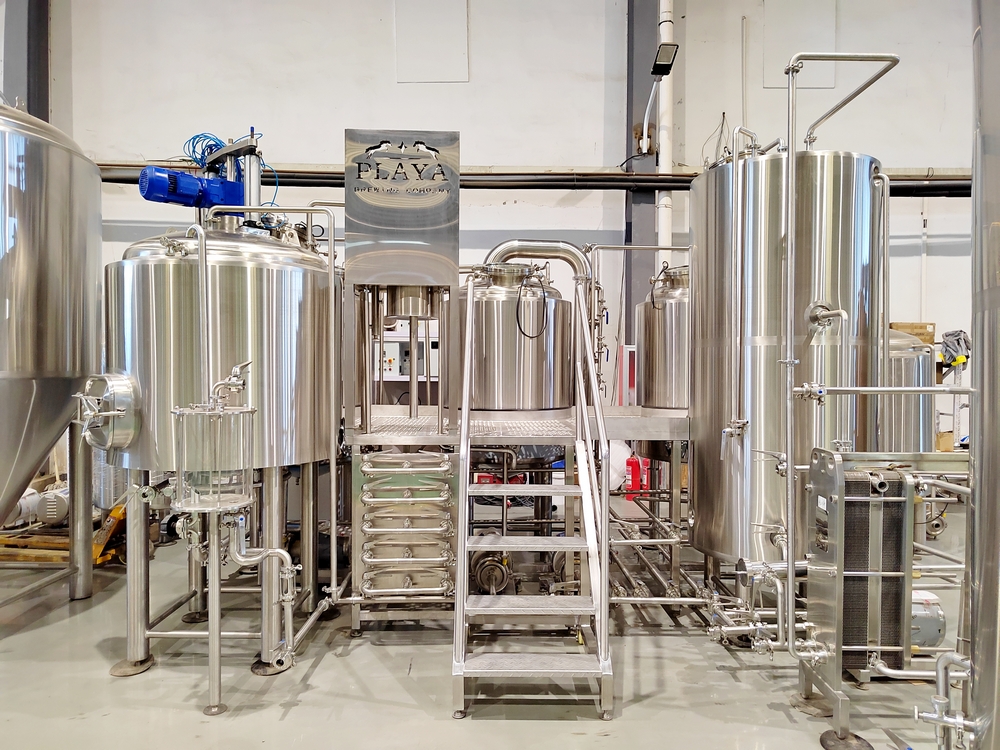
II. Direct Fire Heating
Direct fire heating applies flame or electric heating elements directly to the bottom of the mash tun. The heat passes through the vessel wall into the mash.
1. Heat Transfer Characteristics
Direct fire delivers high heat flux at the bottom surface. The temperature difference between the heating surface and the mash can exceed 100°C. This creates strong convective currents as the heated mash rises and cooler mash descends. The circulation is vigorous but localized — the bottom layer heats rapidly while the upper layers rely entirely on convection to receive heat.
2. Scorching Risk
The primary concern with direct fire heating is scorching. Where the mash contacts the hot bottom surface, sugars and proteins can caramelize or burn. This produces dark specks in the wort, bitter burnt flavors, and reduced fermentability. Once scorching occurs, the affected layer cannot be recovered. The intensity of scorching depends on the heat flux, the mash thickness, and the effectiveness of stirring.
Modern direct fire systems mitigate scorching by using modulated burners, multiple heating zones, and continuous paddle agitation. However, the risk remains higher than with indirect methods, particularly in thick mashes or when heating above 70°C.
3. Temperature Uniformity
Without adequate stirring, direct fire heating creates a vertical temperature gradient. The bottom of the mash may be 5-10°C hotter than the top. This uneven temperature profile leads to inconsistent enzyme activity — enzymes at the bottom may denature prematurely while those at the top remain under-activated. Stirring is essential to redistribute heat, but stirring itself introduces shear and oxygen, which can affect wort quality.
4. Equipment Cost and Footprint
Direct fire systems are generally less expensive to manufacture than steam jacket systems. They require no boiler, steam piping, condensate return, or pressure vessel certification. The mash tun itself is simpler in construction. For small breweries with limited capital, direct fire offers a lower entry cost.
However, direct fire systems consume more energy per liter of wort produced. Heat loss to the surrounding air is higher, and temperature control is less precise than with steam.
III. Steam Jacket Heating
Steam jacket heating uses a sealed chamber around the mash tun wall and/or bottom, into which steam is introduced. The steam condenses on the inner wall of the jacket, releasing latent heat to the mash.
1. Heat Transfer Characteristics
Steam heating provides a uniform heat flux across the entire jacketed surface. The temperature of the heating surface is controlled by the steam pressure — saturated steam at 2 bar is approximately 134°C, while steam at 3 bar is approximately 144°C. This is significantly lower than the flame temperature in direct fire heating, which can exceed 800°C.
The lower surface temperature reduces the temperature differential between the heating surface and the mash, resulting in gentler heating. Convection still occurs, but it is less violent than in direct fire systems.
2. Scorching Prevention
Because the jacket surface temperature is much lower than a direct flame, the risk of scorching is dramatically reduced. Even with minimal stirring, the mash is unlikely to reach caramelization temperatures at the vessel wall. This makes steam jacket heating the preferred method for breweries producing light beers, lagers, and styles where clean malt character is essential.
3. Temperature Uniformity
Steam jackets provide more uniform heating across the entire vessel wall. Multiple independent jacket zones — bottom zone, lower sidewall, upper sidewall — allow the brewer to apply heat selectively. For example, the bottom zone can be used for initial heat-up while the sidewall zones maintain temperature during the rest.
Temperature gradients in a steam-jacketed mash tun are typically 1-3°C from bottom to top, compared to 5-10°C in a direct fire system. This uniformity improves enzyme efficiency and reproducibility between batches.
4. System Requirements
Steam jacket heating requires a boiler, steam piping, pressure reducing stations, condensate traps, and return piping. The mash tun itself must be built as a pressure vessel, with the jacket designed to withstand steam pressure. This increases manufacturing cost and requires periodic inspection and certification.
The boiler adds another piece of equipment to maintain and another fuel source to manage. However, once installed, steam systems offer excellent temperature control and energy efficiency, particularly when condensate is returned to the boiler.
IV. Comparing the Two Methods
| Aspect | Direct Fire | Steam Jacket |
|---|---|---|
| Surface temperature | >800°C at flame | 134-144°C at 2-3 bar |
| Scorching risk | Moderate to high | Very low |
| Temperature uniformity | Poor without stirring | Good to excellent |
| Temperature control | Less precise | More precise |
| Capital cost | Lower | Higher |
| Energy efficiency | Lower | Higher |
| Boiler required | No | Yes |
| Maintenance | Burner maintenance | Boiler + jacket inspection |
V. Which Method Produces Better Wort?
Neither method is inherently superior. The choice depends on the beer styles being produced and the brewery’s operational priorities.
For breweries focused on ales, stouts, and dark beers where some kettle caramelization is acceptable or even desirable, direct fire heating can produce satisfactory results at lower capital cost. Many traditional British ale breweries use direct fire and produce world-class beer.
For breweries focused on lagers, pilsners, and light ales where clarity, clean malt flavor, and precise fermentability are paramount, steam jacket heating offers better control and lower risk of off-flavors.
Some breweries use hybrid systems — direct fire for the initial heat-up and steam for maintaining temperature rests. This combines the rapid heating of direct fire with the gentle, uniform heat of steam during enzymatic conversion.
VI. Practical Considerations for Brewers
When evaluating a mash tun, consider the following:
What beer styles will represent the majority of production? If pale and light beers dominate, steam jacket heating justifies its higher cost.
How many batches per day will the system run? Higher throughput favors steam, as temperature control is more consistent and requires less operator attention.
What is the skill level of the brewing team? Direct fire requires attentive monitoring to prevent scorching, especially during the final ramp to mash-off.
What utilities are already available? If the brewery already has a boiler for other purposes, adding a steam-jacketed mash tun is more economical than installing a standalone direct fire system.
VII. Conclusion
The heating method of a mash tun directly influences wort quality through its effects on temperature uniformity, scorching risk, and enzyme activity. Direct fire heating offers lower capital cost and is suitable for breweries producing darker styles, while steam jacket heating provides superior control and consistency for breweries focused on clean, pale beers. Understanding the trade-offs allows brewers to select the heating method that aligns with their production goals and budget.
Looking for a mash tun with the right heating system for your brewery? Contact us to discuss your production needs.
Ethan
Sales Manager
 English
 French
 Spanish