How the CIP Cart Connects to Every Tank in Your Brewery
- Aug 07, 2026
- 194
- tiantai
I. The Mobile Cleaning Solution for Small and Mid-Size Breweries
Not every brewery has the space or budget for a permanently plumbed CIP station with dedicated tanks and fixed piping. For small and mid-size breweries, a CIP cart offers a practical alternative.
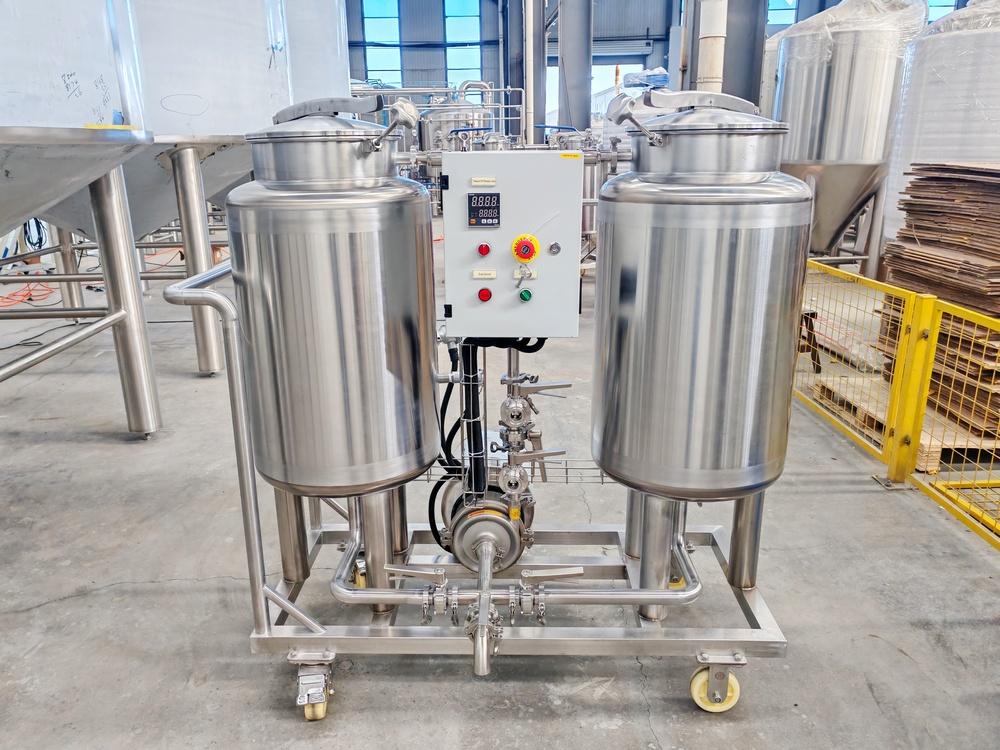
A CIP cart is a mobile cleaning unit mounted on wheels. It typically includes a small tank for cleaning solution, a pump, a heating element, and a control panel — all integrated into a single frame. The operator rolls the cart to the tank that needs cleaning, connects the hoses, and runs the cycle.
Despite its compact size, the CIP cart performs the same essential function as a fixed CIP station: it delivers cleaning solution to the interior of brewing vessels, circulates it under pressure, and returns it for reuse or disposal.
Understanding how the CIP cart connects to each type of tank in your brewery helps you decide whether this mobile solution fits your beer equipment needs.
II. The CIP Cart and Fermentation Tanks
Fermentation tanks are the most frequently cleaned vessels in a brewery. After every fermentation cycle, the tank must be thoroughly cleaned to remove yeast sediment, protein deposits, and hop residues.
The CIP cart connects to a fermentation tank through flexible hoses. The supply hose attaches to the spray ball inlet at the top of the tank. The return hose connects to the bottom outlet or a dedicated CIP return port.
Once connected, the operator sets the cleaning parameters on the cart's control panel — temperature, cycle time, and pump pressure. The cart heats the cleaning solution, pumps it through the spray ball, and circulates it through the tank.
For a typical fermentation tank cleaning cycle, the CIP cart performs:
▶A warm water pre-rinse to flush loose debris
▶A caustic wash at 75°C to 80°C to dissolve organic soils
▶An intermediate rinse to remove caustic residue
▶An acid wash to remove mineral scale
▶A final rinse with fresh water
The mobility of the CIP cart means the operator can move from one fermentation tank to the next without dedicated piping to each vessel. This is a significant advantage in breweries where tanks are spaced apart or added over time.
III. The CIP Cart and Brewhouse Vessels
The brewhouse vessels — mash tun, lauter tun, and kettle — also require regular cleaning. The soils in these vessels are different from fermentation tanks: primarily starch, sugar, and protein rather than yeast and hop compounds.
The CIP cart connects to brewhouse vessels in the same way as fermentation tanks, through supply and return hoses. However, the cleaning parameters are adjusted.
Brewhouse soils respond better to higher temperatures. The CIP cart should be capable of heating the cleaning solution to 80°C to 90°C for effective removal of sugar and protein films.
The lauter tun presents a unique challenge. The false bottom and the space beneath it can trap grain particles. The CIP cart must provide sufficient flow and pressure to flush these areas. A rotary spray ball is recommended for the lauter tun to ensure complete coverage.
Because brewhouse vessels are often larger than fermentation tanks, the CIP cart's tank capacity and heating power must be matched to the vessel size. A cart with a 100-liter tank may be sufficient for a 500-liter kettle, but a 1000-liter kettle would require a larger cart or multiple batches of cleaning solution.
IV. The CIP Cart and the Hot Liquor Tank
The hot liquor tank is both a partner to and a user of the CIP cart.The HLT supplies hot water for the CIP cart's cleaning cycles. Before starting a cycle, the operator fills the cart's tank with hot water from the HLT. This reduces the heating time required by the cart's internal heating element.
Periodically, the HLT itself must be cleaned. Scale builds up inside the tank from repeated heating of water, especially in areas with hard water. The CIP cart connects to the HLT to circulate descaling solution through the tank, removing mineral deposits that reduce heating efficiency.
This relationship means the HLT and CIP cart should be considered together when planning your brewery system. An HLT that can supply hot water at the right temperature reduces the load on the CIP cart's heater and speeds up the cleaning process.
V. Key Features to Look for in a CIP Cart
Tank Capacity
The cart's tank should hold enough cleaning solution for the largest vessel you need to clean. A 50-liter to 100-liter tank is typical for small breweries. Larger carts with 150-liter to 200-liter tanks are available for mid-size operations.
Heating Power
The heating element should be powerful enough to bring the cleaning solution to the required temperature within a reasonable time. A 6 kW to 12 kW heater is common for most applications.Pump Performance
The pump must deliver sufficient pressure to activate the spray ball at the top of the tallest tank. A pump rated for 2 to 3 bar at the required flow rate is adequate for most small to mid-size breweries.Mobility
The cart should have sturdy casters suitable for the brewery floor surface. Locking casters prevent the cart from moving during operation.Control Panel
A basic control panel with temperature display, pump on/off, and a timer allows the operator to run consistent cycles. More advanced carts include programmable cycle sequences.VI. Advantages of a CIP Cart Over a Fixed CIP Station
Lower initial investment: A CIP cart costs significantly less than a permanently plumbed CIP station.
Flexibility: The cart can be moved to any tank in the brewery, regardless of layout.
Easy expansion: Adding new tanks does not require extending the CIP piping network.
Small footprint: The cart occupies minimal floor space when not in use.
Simpler installation: No permanent plumbing or electrical work is required beyond a nearby power and water supply.
VII. Limitations to Consider
Manual connection: The operator must connect and disconnect hoses for each tank, which takes time.Smaller tank capacity: The cart's tank limits the volume of cleaning solution available for a single cycle.
Less automation: Most CIP carts require more operator involvement than a fixed automated CIP station.
VIII. Conclusion
The CIP cart is a practical and cost-effective cleaning solution for small and mid-size breweries. It connects to fermentation tanks, brewhouse vessels, and the hot liquor tank through flexible hoses, delivering the same cleaning capability as a fixed CIP station in a mobile package.When choosing a CIP cart for your brewery, consider the size of your largest tank, the height of your tallest vessel, and the availability of hot water from your HLT. A well-matched CIP cart keeps your tanks clean, your beer quality high, and your investment manageable.
Looking for a CIP cart that fits your brewery's tank configuration and cleaning needs? Contact us for expert advice on beer equipment and cleaning solutions.
Ethan
Sales Manager
[email protected]