Water Deaeration system with high dilution
- Jul 28, 2026
- 174
- tiantai
In modern brewing and beverage production, maintaining product quality while improving production efficiency has become increasingly important. Our Water Deaeration System with High Dilution Technology provides an ideal solution for breweries and beverage manufacturers who require high-quality, low-oxygen water for precise blending and dilution processes. It is generally used for craft breweries, large-scale beer production, non-alcoholic beer, carbonated soft drinks, functional beverages, juice and fermented beverage industries.
By removing dissolved oxygen from water, the system effectively reduces oxidation risks and protects product freshness, flavor stability, and shelf life. The deaerated water is especially suitable for high gravity brewing, where concentrated beer is produced first and then carefully diluted to the target alcohol content while maintaining excellent taste and consistency.
The key advantges of water deaeration system with high dilution:
1. Ultra-low Dissolved Oxygen Level
Advanced deaeration technology reduces oxygen content in water, minimizing oxidation and improving final product quality.
2. Improved Brewing Efficiency
High gravity brewing with deaerated water allows breweries to increase fermentation capacity, optimize tank utilization, and achieve higher production output.
3. Consistent Product Quality
Precise water treatment and dilution control ensure stable alcohol content, flavor profile, and carbonation performance.
4. Food-grade Hygienic Design
Manufactured with stainless steel materials and sanitary components, the system meets the strict requirements of modern breweries and beverage plants.
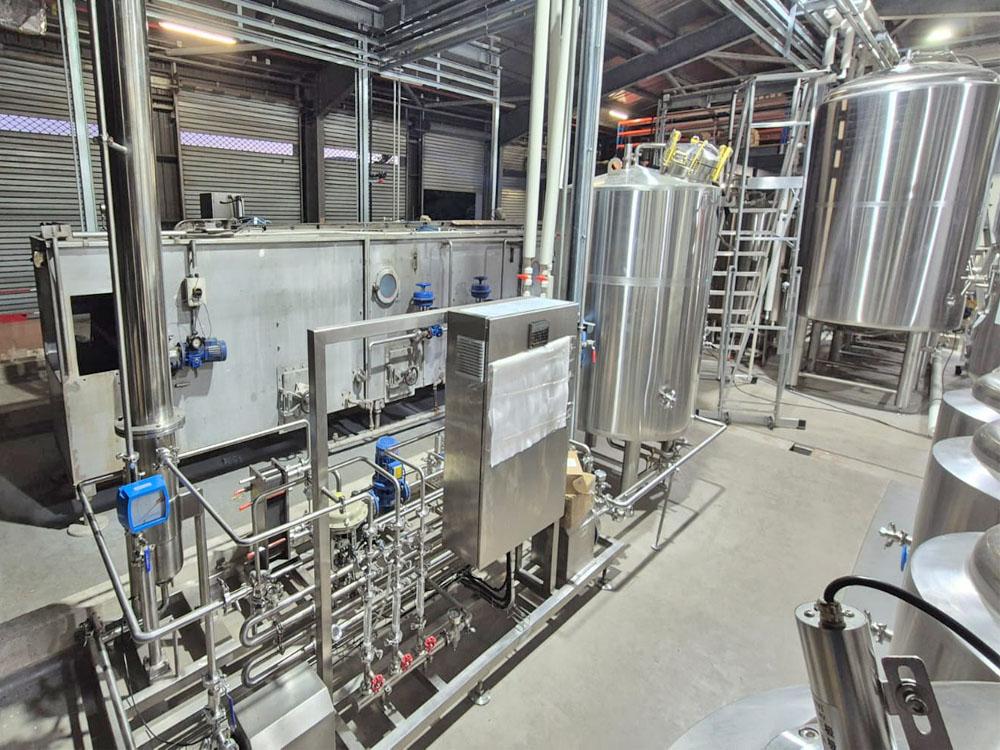
The main components on water deaeartion system with high dilution:
1. Inlet Water Supply Unit:
This system consists of a flow meter, level gauge, pneumatic butterfly valve, check valve, and piping accessories. A stable water supply flow ensures consistent mass transfer between the downward-flowing water film and the upward-flowing CO2 stream within the mass transfer tower. Maintaining relatively constant flow rates for both streams is essential for achieving stable deoxygenation results. The system monitors the inlet water flow rate in real-time and allows for flexible adjustments based on production requirements.
2. Deoxygenation Unit:
This system primarily comprises a deoxygenation tower, gravity flow distributor, high-efficiency packing, the packed tower body, a CO2 injection system, and a centrifugal pump. An advanced flow distribution system combined with an efficient packed tower design ensures that incoming water instantly spreads across the packing surface, maximizing the specific surface area. This facilitates effective mass transfer with the CO2, yielding high-quality deoxygenated water. Instantaneous sterilization occurs simultaneously with high-temperature deoxygenation, and sanitary welding techniques are employed for the process piping.
3. Liquid Level Control Unit:
This unit dynamically monitors liquid levels according to the requirements of different operational stages and controls them via a programmed controller. It consists of a liquid level detection system, a variable-frequency control system, and the corresponding programmed control system.
4. Water Cooling Unit:
This system primarily consists of a plate heat exchanger, a refrigerant temperature control system, and a deoxygenated water temperature control system. A plate heat exchanger is used to enhance efficiency and conserve energy. To further lower the deoxygenated water temperature to the required 2–4°C, the system incorporates a temperature control mechanism; glycol is typically used as the refrigerant. Platinum resistance sensors monitor temperatures, and the PLC calculates and issues commands to dynamically adjust the refrigerant temperature entering the heat exchanger, ensuring the deoxygenated water meets process specifications. Excessively low temperatures could cause icing on the plates, reducing the effective heat transfer area and hindering cooling; however, the system features an automatic adjustment function to ensure robust adaptability to the user's specific site conditions and potential fluctuations in refrigerant temperature.
5. Dilution Water Carbonation Unit (Saturation & Mixing):
Using a uniquely designed mixing and injection device operating at relatively low pressure—and aided by a pressurized piping section—the CO₂ content of the dilution water is raised to (or near) the target range for the diluted beer. This ensures the CO₂ remains stably dissolved in the diluted beer (target range: 0.40–0.50%).
6. CO₂ Automatic Control Unit:
This unit comprises a pressure stabilization system, a one-way check valve, a flow meter, and a pneumatic valve. Under PLC control, the system executes purging or gas displacement operations according to a preset program.
7. Process Monitoring Unit:
A temperature monitoring system ensures the dilution water temperature meets production process requirements. A dissolved oxygen (DO) sensor monitors residual oxygen levels in the deoxygenated water, triggering timely recirculation/deoxygenation and alarms as needed. Real-time monitoring of concentration and CO₂ levels during the beer-water mixing process ensures consistent product quality.
8. PLC Control and Remote Monitoring Unit:
This unit utilizes a Siemens PLC, touchscreen interface, and industrial PC to achieve fully automated system control and to collect/record all on-site data (e.g., water DO levels, beer concentration, temperature). Equipment operating status and production output can be viewed at any time via the supervisory monitoring system.
9. Automatic CIP (Cleaning-in-Place) Unit:
Due to the specialized structure of the packed tower, traditional pipeline and equipment cleaning methods are ineffective. Inadequate cleaning can lead to issues ranging from packing scaling (impairing mass transfer efficiency) to severe problems like microbial contamination or off-flavors. An automated, end-to-end CIP program ensures thorough tower cleaning, prevents carbonate-related scaling and deposits, and ensures the dilution water meets biological quality standards.
10. High-Gravity Dilution and Mixing Unit:
Volumetric Proportioning System: Composed of electromagnetic flow meters, control valves, proportioning pumps, and associated mixing pipe sections. The beer-to-water mixing ratio is regulated by continuously controlling the water flow rate. The target ratio is preset on the control panel; the control system receives flow data from the beer and water lines and adjusts the control valve on the water line to regulate the dilution water flow, thereby ensuring the actual mixing ratio precisely matches the preset ratio.
From water deaeration to accurate dilution control, our system helps producers achieve better efficiency, lower production costs, and higher product consistency. Tiantai, provides turnkey solutions on brewery equipment, winery equipment, cider equipment, distiller equipment, mead equipment etc. If you are looking for water deaeration system with high dilution, we are at your disposal anytime.
Derrick
Sales Manager
[email protected]
Tiantai Beer Equipment
By removing dissolved oxygen from water, the system effectively reduces oxidation risks and protects product freshness, flavor stability, and shelf life. The deaerated water is especially suitable for high gravity brewing, where concentrated beer is produced first and then carefully diluted to the target alcohol content while maintaining excellent taste and consistency.
The key advantges of water deaeration system with high dilution:
1. Ultra-low Dissolved Oxygen Level
Advanced deaeration technology reduces oxygen content in water, minimizing oxidation and improving final product quality.
2. Improved Brewing Efficiency
High gravity brewing with deaerated water allows breweries to increase fermentation capacity, optimize tank utilization, and achieve higher production output.
3. Consistent Product Quality
Precise water treatment and dilution control ensure stable alcohol content, flavor profile, and carbonation performance.
4. Food-grade Hygienic Design
Manufactured with stainless steel materials and sanitary components, the system meets the strict requirements of modern breweries and beverage plants.
The main components on water deaeartion system with high dilution:
1. Inlet Water Supply Unit:
This system consists of a flow meter, level gauge, pneumatic butterfly valve, check valve, and piping accessories. A stable water supply flow ensures consistent mass transfer between the downward-flowing water film and the upward-flowing CO2 stream within the mass transfer tower. Maintaining relatively constant flow rates for both streams is essential for achieving stable deoxygenation results. The system monitors the inlet water flow rate in real-time and allows for flexible adjustments based on production requirements.
2. Deoxygenation Unit:
This system primarily comprises a deoxygenation tower, gravity flow distributor, high-efficiency packing, the packed tower body, a CO2 injection system, and a centrifugal pump. An advanced flow distribution system combined with an efficient packed tower design ensures that incoming water instantly spreads across the packing surface, maximizing the specific surface area. This facilitates effective mass transfer with the CO2, yielding high-quality deoxygenated water. Instantaneous sterilization occurs simultaneously with high-temperature deoxygenation, and sanitary welding techniques are employed for the process piping.
3. Liquid Level Control Unit:
This unit dynamically monitors liquid levels according to the requirements of different operational stages and controls them via a programmed controller. It consists of a liquid level detection system, a variable-frequency control system, and the corresponding programmed control system.
4. Water Cooling Unit:
This system primarily consists of a plate heat exchanger, a refrigerant temperature control system, and a deoxygenated water temperature control system. A plate heat exchanger is used to enhance efficiency and conserve energy. To further lower the deoxygenated water temperature to the required 2–4°C, the system incorporates a temperature control mechanism; glycol is typically used as the refrigerant. Platinum resistance sensors monitor temperatures, and the PLC calculates and issues commands to dynamically adjust the refrigerant temperature entering the heat exchanger, ensuring the deoxygenated water meets process specifications. Excessively low temperatures could cause icing on the plates, reducing the effective heat transfer area and hindering cooling; however, the system features an automatic adjustment function to ensure robust adaptability to the user's specific site conditions and potential fluctuations in refrigerant temperature.
5. Dilution Water Carbonation Unit (Saturation & Mixing):
Using a uniquely designed mixing and injection device operating at relatively low pressure—and aided by a pressurized piping section—the CO₂ content of the dilution water is raised to (or near) the target range for the diluted beer. This ensures the CO₂ remains stably dissolved in the diluted beer (target range: 0.40–0.50%).
6. CO₂ Automatic Control Unit:
This unit comprises a pressure stabilization system, a one-way check valve, a flow meter, and a pneumatic valve. Under PLC control, the system executes purging or gas displacement operations according to a preset program.
7. Process Monitoring Unit:
A temperature monitoring system ensures the dilution water temperature meets production process requirements. A dissolved oxygen (DO) sensor monitors residual oxygen levels in the deoxygenated water, triggering timely recirculation/deoxygenation and alarms as needed. Real-time monitoring of concentration and CO₂ levels during the beer-water mixing process ensures consistent product quality.
8. PLC Control and Remote Monitoring Unit:
This unit utilizes a Siemens PLC, touchscreen interface, and industrial PC to achieve fully automated system control and to collect/record all on-site data (e.g., water DO levels, beer concentration, temperature). Equipment operating status and production output can be viewed at any time via the supervisory monitoring system.
9. Automatic CIP (Cleaning-in-Place) Unit:
Due to the specialized structure of the packed tower, traditional pipeline and equipment cleaning methods are ineffective. Inadequate cleaning can lead to issues ranging from packing scaling (impairing mass transfer efficiency) to severe problems like microbial contamination or off-flavors. An automated, end-to-end CIP program ensures thorough tower cleaning, prevents carbonate-related scaling and deposits, and ensures the dilution water meets biological quality standards.
10. High-Gravity Dilution and Mixing Unit:
Volumetric Proportioning System: Composed of electromagnetic flow meters, control valves, proportioning pumps, and associated mixing pipe sections. The beer-to-water mixing ratio is regulated by continuously controlling the water flow rate. The target ratio is preset on the control panel; the control system receives flow data from the beer and water lines and adjusts the control valve on the water line to regulate the dilution water flow, thereby ensuring the actual mixing ratio precisely matches the preset ratio.
From water deaeration to accurate dilution control, our system helps producers achieve better efficiency, lower production costs, and higher product consistency. Tiantai, provides turnkey solutions on brewery equipment, winery equipment, cider equipment, distiller equipment, mead equipment etc. If you are looking for water deaeration system with high dilution, we are at your disposal anytime.
Derrick
Sales Manager
[email protected]
Tiantai Beer Equipment
.jpg)